7th Play - Death Tax by Lucas Hnath
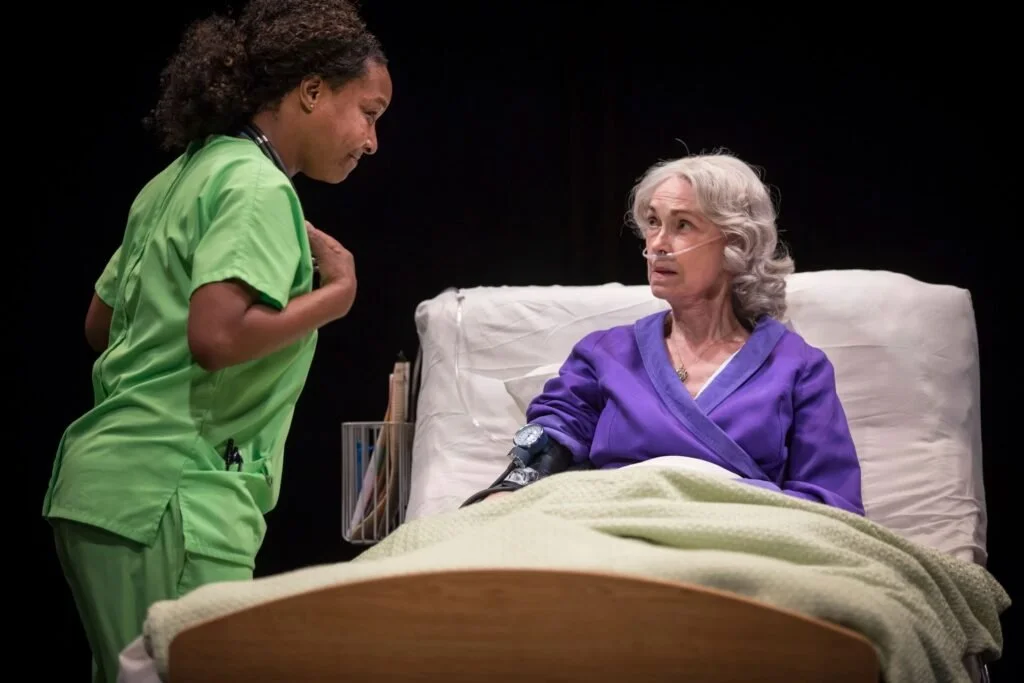
J. Nicole Brooks (Tina) and Deanna Dunagan (Maxine) in the Chicago Lookingglass production in 2014. Photo: Liz Lauren
Lucas Hnath is a clever and popular writer these days. So when I stumble across a play of his that I haven’t read, it’s exciting. Also, the name “Death Tax,” is enticing - what does that say about me? Hmmm… That being said, this play is less about taxes (that’s good news for most of us), but more about lies and not knowing who is telling them. I could never tell who was telling the truth, and neither could the characters in the play. There is clear commentary about aging in America, with our ridiculously broken health care “system,” that is less the focus of this play than I would like it to be, but the criticism is there. I think the playwright is more focused on creating characters that are all both heroes and villains of the story in moments, so you don’t really know what is going on, or how you feel about them. This makes the characters multi-dimensional, the audience doesn’t know who to care about or trust, and while I love when playwrights do it for certain characters, in this play, it does make it hard to care about any of them.
Summary: “It's December 2010. Infirm Maxine thinks her daughter is paying Nurse Tina to gently nudge her into the grave before the new year. Maxine thinks Tina's doing this so her daughter doesn't have to pay hefty estate taxes, taxes that take effect on January 1. Nurse Tina adamantly denies Maxine's accusations, but when Maxine offers Tina a portion of her sizable estate on the condition that she lives until the 1st, Tina changes her tune. But of course, the plan doesn't go according to plan.” Concord Theatricals
Laura’s thoughts in brief: Frankly, as a child with an aging parent, this one was hard to read. I think that’s part of Hnath’s point, but it hits way too close to home for many of us. We don’t really know what is going on in a place we pay to care for the aging people we love, but we’re not able to care for them ourselves. This results in guilt and anguish all around, and we definitely see that here, but that lesson doesn’t really need to be taught to us. But it may for others, so, I’m not saying it’s not a point to be spoken to.
That all being said, this is an interesting play that draws you through it, trying to figure out who is lying and who we should root for. As I noted before, Hnath doesn’t really give us that, which left me just feeling a little gross at the end, which I think was his point, but I didn’t love that.
I was VERY surprised to see that Lookingglass did a production of this show. While the extreme talent that Lookingglass could attract (Tony-winner Deanna Dunagan and J. Nicole Brooks!), it’s just not the kind of show that needs Lookingglass’s money and ability to literally make magic in their theatre. I love what Lookingglass can do, and it seems a shame to waste that. Redtwist also did a production of this in 2020, and I think this must have been a perfect show for the tiny, intimate Redtwist space, with a couple locations and only 4 characters. Hnath’s instructions for the setting are “it should be mostly bare. Except for a bed or a chair or chairs, when it is needed. Whatever is needed. Nothing more.” Why on earth would we need the great $$ and imaginative resources of Lookingglass for this? But, I digress.
A good play with some important points to make about dying and healthcare which are still very relevant in the ten plus years this play has aged, unfortunately. Not an easy read or watch, but interesting as we don’t know who to believe, although that makes us care less about everyone which was a bit of a challenge to me.
READ MORE! Here’s what some of the critics had to say about productions:
https://www.newcitystage.com/2014/09/15/review-death-taxlookingglass/
https://www.austinchronicle.com/arts/hyde-park-theatres-death-tax-11775446/