5th Play - Liberation by Bess Wohl
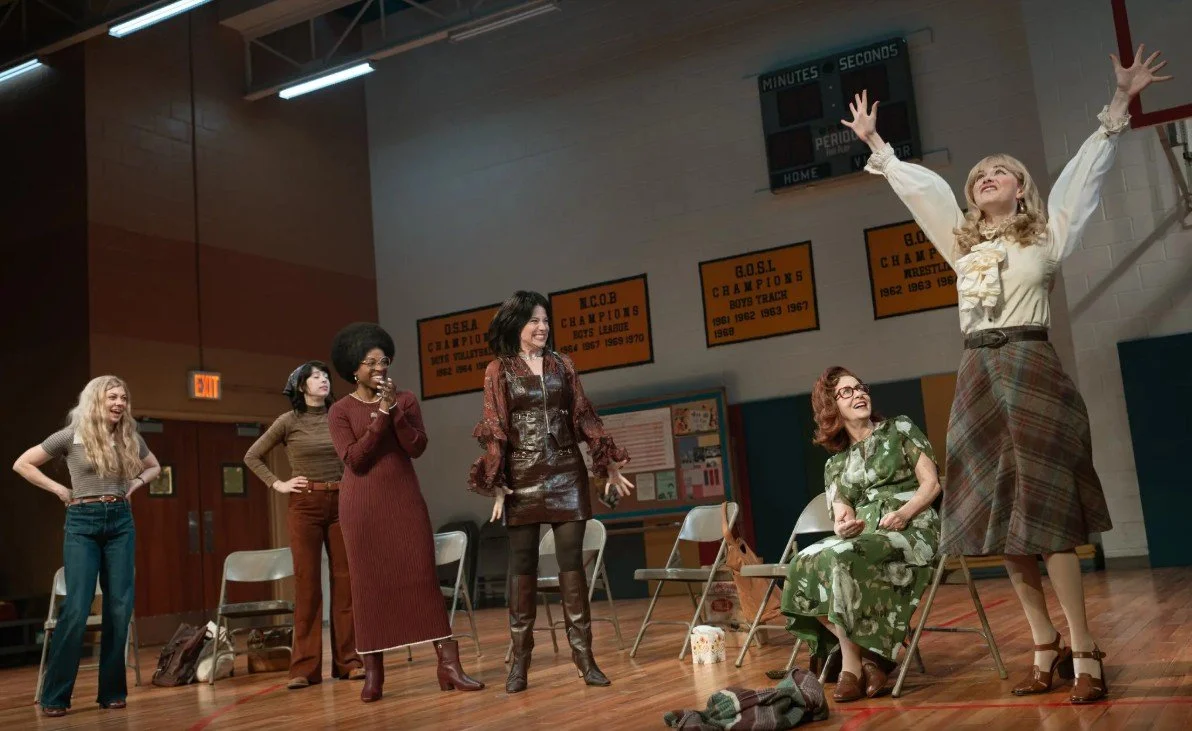
Susannah Flood (Lizzie), Adina Verson (Susan), Kristolyn Lloyd (Celest), Irene Sofia Lucio (Isadora), Betsy Aidem (Margie) and Audrey Corsa (Dora) in the Broadway production in 2025. Photo Credit: Little Fang
Wow, a play about women’s liberation? What’s not to love? No, really, this isn’t JUST about women’s lib, it’s a story about the lives of several wonderfully three dimensional female characters from the 70’s who were part of the massive changes that came about at that time (and much more). It feels so very timely now, as in a twist I thought could never happen in this country, those changes are starting to be rolled away (?!!) and some people in our country want to take even more away. This play was not what I expected, but maybe better than I expected. A celebration of a tiny slice of what women at the time were dealing with and had to go through, but not as one-sided as it may sound. The value of seeing the humanity behind the “movement” is why I loved this play.
Summary: “It’s 1970. Somewhere in Ohio, six women meet on a basement basketball court to form a consciousness-raising group, determined to shake up their lives and change the world. Fifty years later, one of their daughters tries to understand where things fell apart. A provocative, wildly theatrical play that poses vital questions about friendship, legacy and the true meaning of liberation, investigating what we inherit, what we forget, and what we’re still fighting to understand.” Concord Theatricals
Laura’s thoughts in brief: Until I read some of the reviews, I kept thinking of this show as an all-female cast, forgetting that there was a man in the show. And while his role is smallish but pivotal to the plot of Lizzie’s story, it’s important as well. Not just to the plot, but to the version of the 21st century male who feels like they are being lost and othered right now. They are othered in this play, very much so, but it also shows the love that narrator Lizzie’s mom (the real Lizzie - sorry that’s confusing) had for that man, and how that changed her. We don’t hate men, we just want choices and equality. (Doesn’t sound so hard, and yet …) But, it was SO refreshing to see a play fully centering WOMEN!!!
I loved all of the characters in this play, and would watch a whole play about each of their stories. One of the reviews discussed them in a much better way than I could, so using a quote here from Lauren Novek’s review in exeunt-NYC: “Lizzie herself, twenty-something and white, is an aspiring journalist with a degree in international relations, stuck on the weddings and obituaries beat at an Ohio newspaper. Margie (Betsy Aidem) is a late-middle-aged white woman desperate to get a break from her retired, retrograde husband before she snaps and stabs him; she has two grown sons. Susan (Adina Verson), a radical Jewish activist disowned by her family (it’s implied but not quite said at the outset that it’s because she’s a lesbian), has wound up living in her car and is desperate for her life to move forward. Isidora (Irene Sofia Lucio) is an aspiring Italian filmmaker in a green card marriage but with real political ambitions. Celeste (Kristolyn Lloyd), a Harvard-educated Black editor and writer who’s been dragged back to Ohio to care for her slowly dying mother, needs intelligent people to talk to now that her passionate reader of a mother is descending into dementia. And Dora (Audrey Corsa), a pretty young white secretary who thought she was joining a knitting circle, leaps in to feminism with both feet.” I thought this description was wonderfully well-articulated, and don’t you just want to know more about each of these characters?! Read the play! But you’ll still want more, just saying, because this story belongs to Lizzie and/or her daughter. Lizzie is both our narrator from the present and “plays” her mother (confusing to write about, but I felt like it worked in the play). She wants to know more about her mother who has died, and answers to questions she never asked. For those of us who have lost parents, that issue itself seems like it might be worth a whole play.
One other moment that stuck out to me is when the Black character Joanne comes in to the space looking for her son’s backpack, and that’s the first time we’ve seen her and all we see from her. We’re wondering, why, what’s up, why are we wasting this actor’s time for this? She reappears in the second act, summoned by narrator Lizzie to play her mother in a love scene with Lizzie’s dad (too creepy for daughter Lizzie). Joanne agrees, saying, “I mean, I haven’t really done much so far, so, why not? … I’m not even sure why I was there. I’m being underutilized. Not the first time. … But I wouldn’t mind feeling how it feels to be in the center of the story.” HELLO! Then after that scene between Joanne playing mother Lizzie and Bill (daughter Lizzies father), there’s an even better scene between Joanne and Celeste, where Joanne reminds Celeste (and us) about some of the challenges Black women (and really, other women too) had with the women’s movement. “No normal woman with school-aged children can join a group that meets consistently at six p.m. on a school night. … You make a women’s group that women can’t come to.” It’s a great recognition of the fact that this is really a white woman’s story, even with Celeste as an important character. Cop-out or acknowledgement by the playwright? I wasn’t sure, but I personally appreciated this part of the play. But, I’m a white woman, so …
I would LOVE to direct or act in this play. (Chicago? Call me!) My one hesitation (for me and for any future productions) is that there is a whole scene where all the women are meeting completely naked, based on a recommendation from Ms. magazine (or not? apparently all the “groups” were doing it according to Dora). While this definitely allows for the vulnerability and awkwardness the play is looking for, I think it will be challenging for both actors and audiences, especially in smaller spaces. That being said, as an Intimacy Director, I’m trying to think of some clever ways to handle this for actors whose boundaries do not reach to them being completely naked in a play for a whole scene.
There’s so much to dig into in talking about this play. These reviews have great points and tell a lot about the play that I don’t have time to do. But I highly recommend reading it, although seeing a production would be way more interesting. I know they’re doing it at the Milwaukee Chamber Theatre this year - hoping I get to go!
READ MORE! Here’s what some of the critics had to say about productions:
https://www.nytimes.com/2025/10/28/theater/liberation-review-broadway-bess-wohl.html
https://exeuntnyc.com/reviews/review-liberation-at-the-laura-pels-theatre/
https://variety.com/2025/legit/reviews/liberation-review-broadway-1236562420/