6th Play - Women Playing Hamlet by William Missouri Downs
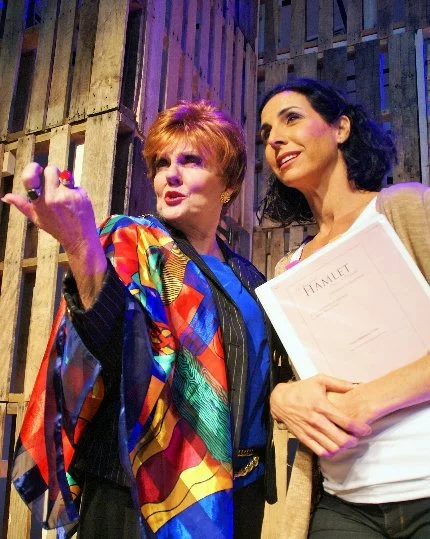
Kitt Marsh (Gwen) and Susie Kreitman Taylor (Jessica) in Florida’s New Theatre production in 2015. Photo by Eileen Suarez
Once again, the title grabbed me. And yes, I totally judge books by their covers - it may be a fatal flaw, but I’ve read some VERY interesting and fun books because of it. Also a couple of duds, but not many! Knowing the history of a few women who played Hamlet over the years (why isn’t it happening more often?!!!), and also knowing that no females got to play that character or any of them in Shakespeare’s time, I was drawn to this play merely for the title. But the play was a fun romp through some of the anxiety that actors go through, especially when playing such a well-known and now archetypal character.
Summary: “Hamlet’s a challenge for any actor, but when Jessica is cast as the titular character in a New York production, it sends her into an existential tailspin. It doesn’t help that her acting coach is borderline abusive, or that every Starbucks barista with an MFA tells her she’s too young for the role. Or that she’s somehow managed to make Sir Patrick Stewart her nemesis. Not to mention the fact that she’s a woman. How can Jessica figure out “to be or not to be,” when she can’t even figure out herself? Featuring an all-female cast performing multiple roles, Women Playing Hamlet is rip-roaring fun for Shakespeare fans and haters alike.” Concord Theatricals
Laura’s thoughts in brief: First of all, this play was written in 2015, and that age shows a bit to anyone who’s been paying attention to the changes in acting methods and pedagogy since 2020. That being said, for those of us who lived through the self-righteous, often cruel, but still somehow powerful acting teachers in the 80’s/90’s (no, not all of them, but that was the style!), this play is funny in an “ouch, I’ve been there” way. Is this play funny to non-theatre people? Good question. I have no clue. It’s VERY meta-theatrical, and written about and for theatre folk, I believe.
That all being said, I have to love a play with tons of characters, some of which are male, but that stipulates that “women must play all the male roles” as a wonderful revenge for Shakespeare’s time. Love that! I also love that the show can be done by 4 to 19 women. Great for storefront AND university productions. It also gives agency to the director, too. I would enjoy directing a production of this, although I really want to play the obnoxious acting teacher Gwen first - I have the scarves for her! This is NOT the kind of acting teacher I am (despite the scarves), but it’s fun to make fun of the OG’s.
The play moves fast and is fun, but there are a couple things I liked less. First of all, the main character Jessica is ANNOYING, and somewhat unbelievable. Anyone who is skilled enough to get both a recurring soap role and the lead in Shakespeare’s most famous play (and has an MFA!), should not be THAT worried about her acting chops. So, I struggled with this important conceit of the show. Anxiety about playing a famously difficult character is real, yes, but the way the play is written makes you feel that Jessica is very green and has limited acting skills, which simply can’t be true to acheive what she has already achieved, which is not inconsiderable (MFA, soap role, cast as Hamlet). Many of us would consider this a VERY successful career at 29. Does it mean she can live on this or should not be concerned about next steps in her career? Of course not, but ….
There are some definite points being made about acting training, as well as how hard it is to be an actor, especially in Manhattan where everyone Jessica meets also has an MFA. I found that to be quite funny, if maybe in a painful way (it’s why I live in Chicago, not NYC or LA). The idea though, as spoken by MANY of the other characters, that she is too young to have had enough life experience to play Hamlet rubs me the wrong way a bit - many of us teach that the imagination and research are how we explore experiences we’ve never had, so her age should NOT be relevant. And yet, actors do season and deepen with time and experience. However, I both like and dislike how the acting teacher is asking Jessica to know herself better in order to be better in the role. Dislike because I don’t think Jessica needs to bring her own personal traumas to the role to be successful in it, but like because I do believe that it is important for good actors to really have a good understanding (and acceptance) of who they are and their own points of view about things. Knowing themselves, they can shift and adjust to play characters who are both alike and different. Sorry, maybe too much acting pedagogy, but that’s my job and what I like to talk about!
Overall, I enjoyed reading the play, but worry that the audience for it is tricky - the target audience is theatre folk, but the play’s a little dated and the humor isn’t quite clever and surprising enough for the theatre audiences with whom I usually work in Chicago. I think this would be great in a college setting, or in a smaller theatre community. That being said, a well-done professional production would be fun to see. Potentially pairing this with a production of Hamlet would be a fun marketing idea, and fun for a theatre company. Redtwist did this with Titus and Gary, a play that takes place the morning after the bloody dinner party at the end of Titus. I’m not sure this one is as clever as Gary, but it would be fun!
READ MORE! Here’s what some of the critics had to say about productions: