8th Play - Creature by Heidi Schreck
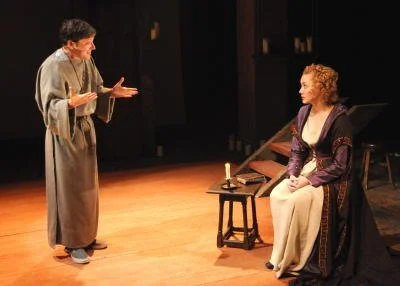
Jeremy Shamos (Father Tom) and Sophia Jean Gomez (Margery) in the New Georges 2009 production in NYC. Photo Credit: Jim Baldassare
I’d heard of this play and when I stumbled upon a copy, I was excited to read it. It’s the kind of period play that I love - in the same style as modern writers Lauren Gunderson and Kate Hamill, it’s written in a historical time period, but in fairly modern language with a specific eye toward the 21st century audience. I enjoyed the wacky theatrics of Margery, the main character, while also being annoyed with her for using her quite considerable privilege (at a time when most people, let alone women, had very little) to ignore her responsibilities and generally cause problems to the people around her in the name of religious fervor. I did have very mixed feelings about this character, but enjoyed seeing a woman of this time (England in the 1400’s) who actually has some agency. Alas, many women with agency at this time were being burned at the stake, which is also noted in this play.
Summary: “After being pestered by devils for more than half a year, Margery Kempe – new mother, mayor's daughter, and proprietress of a highly profitable beer business – is liberated from her torment by a vision of Jesus Christ in purple robes. Visions are hard to come by, even in 1401. Should we trust the new Margery, with her fasting and her weeping and her chastity fixation, or burn her with the other heretics? Can a woman of insatiable appetites just up an audition for sainthood? Playwright and Obie-winning actor Heidi Schreck conjures a collision of contemporary and medieval imaginations: a very funny, little bit scary new play about faith and its messengers.” Concord Theatricals
Laura’s thoughts in brief: The character of Margery, the titular “Creature,” definitely challenged me. As I mentioned I both liked and was very annoyed by her. I did appreciate that even though it felt like it was implied that her religious crying and wailing was oftentimes not real, done for show, that it did seem that she really believed that she had a vision and thus a calling. Without that belief (however ridiculous it may seem to other characters and us as the audience), I would probably have written the character off.
I enjoyed the other characters a lot. Asmodeus, a devil who comes to tempt her, is fun, and deliciously, unapologetically wicked, “Aren’t babies cute? … Sometimes … we…pick up one baby and blow air into the baby like a balloon and then we play catch with it.” John, the supportive and suffering husband is easy to empathize with at first - someone’s got to take care of the baby, and also when Margery decides she can’t sleep with him anymore if she’s going to be a saint. Until he asks the Nurse to sit on his lap … We have Father Thomas, a youngish priest, who is baffled as to how to deal with Margery, who he sees as a fraud, but then gets hung up when she tells him that in her vision, Jesus told her that he (Father Thomas) would die in seven years. It’s fun to see his attitude to Margery shift, and by the end of the scene, he actually offers to read to her from an English Bible, the owning of which could actually get you burnt at the stake in the 1400’s. We also have Juliana, an anchoress who has had visions like Margery, and whose book Father Thomas reads to Margery. She first comes to Margery as the voice of a hazelnut (I LOVE that wonderfully weird and creative idea - I directed Sara Ruhl’s Melancholy Play a while ago in which a character turns into an almond - more nuts in plays!!). Then Margery goes to visit Juliana and finds her to be just as human as Margery, revealing that she no longer has visions except of her cat, and some very interesting and slightly unorthodox religious opinions. “Sometimes I think that Confession was invented just to give the poor priests a little taste of life.” Juliana is very real and delightful to us, the audience, even if she’s a bit of a disappointment to Margery, although Margery does learn from her. I love the idea of Juliana being a celebrity to Margery, and then watching her discover that she’s just a real human like everyone else. This is a message that I think is interesting and very relevant in our time.
I was disappointed in the ending of the play. It came very quickly after Margery’s visit to Juliana, and was a little quick and not as believable as the rest of the play (I bought the almond and the devil, but not the ending, hmm…). It feels like more time is needed to see how Margery changes. But overall, I enjoyed this play - it would be fun to see and do. I think there are some issues about performative religion, responsibility and celebrity, and others that are worth exploring with the show. Additionally, it’s just funny on top of those, and it moves - I was never bored reading and felt drawn to find out what happened next. Someone do it! Call me to direct!
READ MORE! Here’s what some of the critics had to say about productions:
https://www.nytimes.com/2009/11/06/theater/reviews/06creature.html
https://www.newcitystage.com/2015/11/05/review-creaturedandelion-theatre/