18th Play - An Octoroon by Branden Jacobs-Jenkins
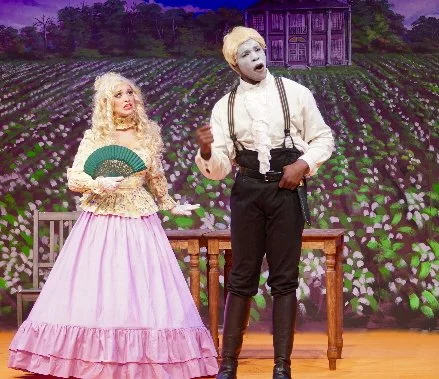
Mallory Newbrough (Dora) and Robert Richards Jr. (BJJ/George) in Area Stage Company’s 2017 production in Coral Gables, FL. Photo courtesy of Area Stage Company
Ever since working on Jacob-Jenkins’ Appropriate, I have thought of him as one of the 21st century’s greatest playwrights. He is not afraid to rock the boat to make a statement about race, and yet even his most problematic characters remain fully dimensional. I have heard about An Octoroon for a while, and was excited when I stumbled across a copy. And…wow. It was both more and less than what I expected. There is nothing subtle about this play, which is clearly the intent. There are very differing opinions on how successful the show is. I found myself to have mixed opinions, but enjoyed a lot of it. CONTENT DISCLOSURE: slavery
Summary: “Judge Peyton is dead and his plantation Terrebonne is in financial ruins. Peyton’s handsome nephew George arrives as heir apparent and quickly falls in love with Zoe, a beautiful octoroon. But the evil overseer M’Closky has other plans – for both Terrebonne and Zoe. In 1859, a famous Irishman wrote this play about slavery in America. Now an American tries to write his own.“ Concord Theatricals
The top of the play starts with a Black playwright in his underwear (named BJJ - see? not subtle) talking about the challenges of being a Black playwright, then putting on whiteface makeup as we watch. Then he gets into a fight with a white character (“Playwright”) who turns out to be Dion Boucicault, who wrote the original anti-slavery play The Octoroon in 1859. This playwright proceeds to talk about his own life and career (fun historical facts, actually!) as he puts on redface, complete with Indian headdress. Oh boy. Like I said, not subtle.
Then we launch into Jacob-Jenkins’ version of Boucicault’s play, starting with a conversation between slaves Dido and Minnie. The stage directions read, “I’m just going to say this right now so we can get it over with: I don’t know what a real slave sounded like. And neither do you.” Actually, the two sound a lot like 21st century women, with moments where the anachronism of that is both funny and painful, like in moments like when Minnie says: ”I met him and Darnell through her at a slave mixer over by the river before she dumped him because, you know, she couldn’t deal with the long-distance … Can you believe that Mas’r Peyton’s been dead for two months?” It’s a very funny scene with some very uncomfortable moments, but sets us up to expect more of that.
Next arrive Dora (a white woman, played by a white actor) and George, who is played by BJJ in whiteface and blonde wig. The the two of them liberally sprinkle their dialogue with the n-word. It’s hard to read (and I’m sure hard to hear in the theatre), but that’s clearly intentional on Jacob-Jenkins’ part. When George says, “Here, though, the negro race is so quaint and vibrant and colorful…” it’s hard to decide if it’s better or worse to have a Black actor speaking those lines. George and Dora are intentially overblown characters and lean towards melodrama as they lay out exposition. Eventually we meet Zoe, the “octoroon” of the title. At this point neither we or she realizes that she is technically one-eighth Black, which is what “octoroon” means. Of course, George falls in love with her. He exits and after just a few lines, BJJ comes back playing another white character, M’Closky, who is clearly our Villain, and who also falls for Zoe. There’s also an Indian, Wahnotee, played by the Playwright in redface. Whew!
There’s a lot more wacky plot that comes from Boucicault’s play, although the more time we spend in the original, the less interesting I found Jacob-Jenkins’ play. I found one of the reviews captured this feeling nicely: “Jacob-Jenkins makes his thematic points relatively early and then doesn’t really come up with much else during the expanse of a 2-½ hour play. The result is the sense that this goes on too long.” (Bill Hirschman, Florida Theater on Stage.) That’s kind of how I felt. I wasn’t THAT interested in the plot of the original melodrama either.
But when you read the reviews, they vary enormously. Branden Jacob-Jenkins received a $625K MacArthur Genius grant for this play, and some people think it’s one of the most ingeniously clever plays about race for a long time. Others think that he makes some great points and then loses his way. Fascinating to see how different they are!
I’m glad I read the play, and I would definitely love to see it. It’s a risk to do, as people will clearly love it and hate it. And white people WILL be uncomfortable. But, I’m pretty sure that’s the point. A very interesting piece.
READ MORE! Here’s what some of the critics had to say about productions:
https://chicago.suntimes.com/2017/7/28/18342211/in-an-octoroon-everything-old-is-made-new-again