16th Play - Sap by Raffaela Marcus
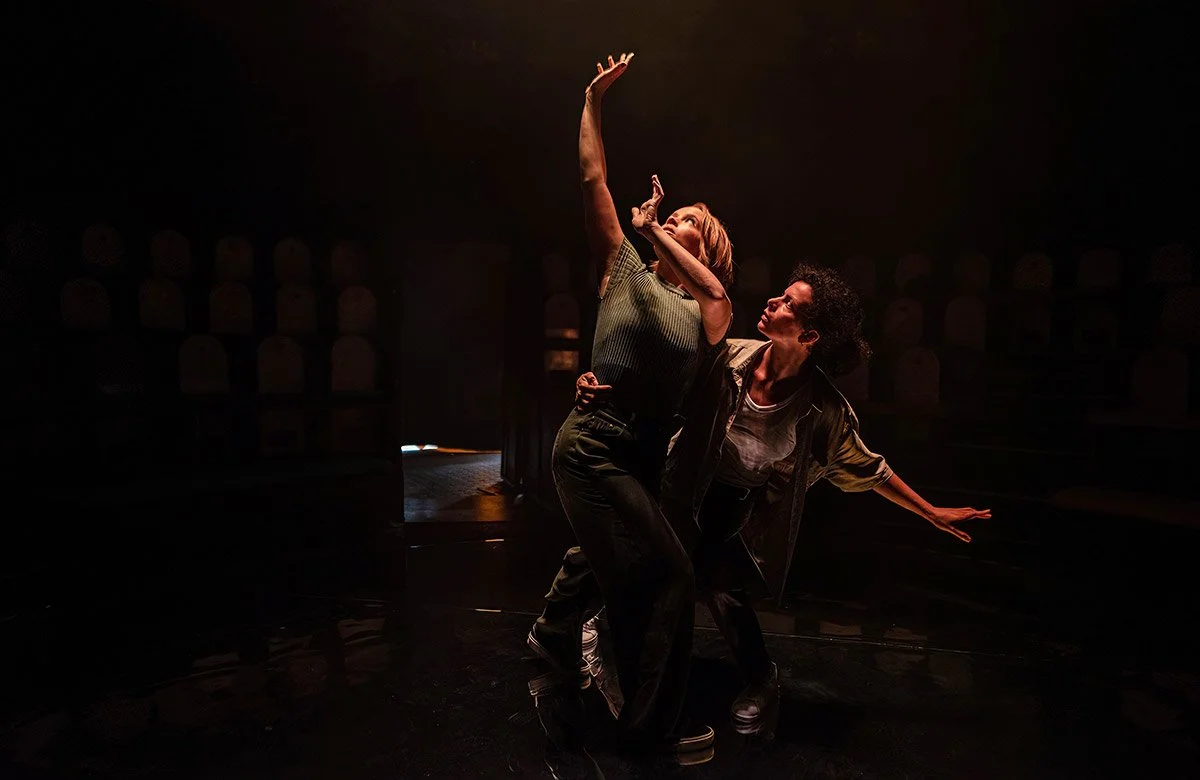
Jessica Clark (Daphne) and Rebecca Banatvala in the Soho Theatre production in London in 2023. Photo credit: David Monteith-Hodge
Biphobia is an important issue to me. It’s not one people think about a lot, unless they’re being affected by it. People think that being bi is easier because you can “pass” as straight, which can potentially be a privilege. But coming out of a closet you’re not 100% sure you’re in can be a real tricky thing to do. Also, to be discriminated against by people who know how terrible discrimination is, and then to be told you’re not queer enough is rough treatment that many bi folx have been subjected to. In addition to this important issue, this play is wonderfully creepy and draws you right along! I read this play because I am fortunate enough to be working with The Front Theatre as the Movement and Intimacy Director for a production of this beautiful and heartbreaking piece starting next January. Come see it! Maybe come audition …
Summary: “A myth, a lie, a tree. This is a story with a crime at its heart. When a woman tells a lie to her girlfriend, a seed is planted that starts to grow in the darkness. Now roots are cracking up through the pavement and branches are coming in at the windows, and – as Daphne starts to see things that no one else can – she becomes the focus of some seriously unwanted attention. A loose reimagining of a certain myth, this is a queer urban fable about bisexuality and biphobia.” https://elliekeelproductions.co.uk/
Laura’s thoughts in brief: I personally have been fortunate to have been embraced and accepted on my own bisexual journey (although it still feels weird to use that word - I don’t love it), but I didn’t really come out completely until the 20’s, when the word “queer” was repurposed and made inclusive. I'd rather be called queer, frankly. Anyway, most of the young people I’ve met recently (and I actually meet a lot, in rehearsals and classes) don’t really care what you dress like or who you love. I do have dear friends who have suffered from biphobia in the past, and I still hear comments about people “not knowing what they want.” Alas, bi folx do know what they want. They want a person to whom they are attracted to, whether that person presents masc, femme or somewhere in between.
At first on reading the play, I was put off a bit when I realized the whole thing is written as Daphne’s monologue. Personally, I’m not a big fan of monologues in plays, either as an actor or a director. They’re necessary (exposition!), but I think some playwrights overuse them. So, that was kind of a turnoff at first. The playwright DOES specify that “descriptions of speech (e.g. ‘she says, suddenly alert” may be taken as stage directions.” And also that “there is no fixed number of actors that should perform this play.” She also indicates that as the play goes on, it shifts into more traditional play format deliberately. I do appreciate this flexibility on performance, and am interested to see how it plays out! The original production had two actors, one playing Daphne and one playing everyone else. But you could cast different actors in all the roles - that would be about 4? You could even have a chorus (it’s based on a myth, after all). The monologue structure does give some really beautiful description that you wouldn’t get in a traditional dialogue format, and you can imagine some really wonderful movement work that could happen in these moments. Or at least I can!
Daphne’s one night encounter with a man that we see at the beginning of the play is at the core of her dilemma with her new girlfriend, who has issues with bisexual women. And instead of owning up to her bisexuality early on in the relationship, Daphne chickens out, and then we have the lie. When her one night stand shows up with connections to her girlfriend, we see that the problem is coming to the fore, whether Daphne wants it to or not. Like a novel where there is a revelation that means you’re going to have to stay up all night to finish it, the play is like an unstoppable train, moving toward a cataclysmic ending. We don’t know what the ending will be, but we know it will be dramatic and complicated and problematic. It’s fascinating and jaw-dropping in moments.
In addition to biphobia, this play tackles sexual assault, stalking and more. There are a LOT of potent issues in this play and I am so excited to help Charles Riffenburg, the director, and the actors and design team to bring it to life physically, and in a way that everyone knows their boundaries are perfect exactly where they are!
READ MORE! Here’s what some of the critics had to say about productions:
https://theblogoftheatrethings.com/2023/04/07/review-sap-at-soho-theatre/
https://playstosee.com/reviews/sap/
https://www.londonpubtheatres.com/review-sap-by-rafaella-marcus-at-soho-playhouse-23-22-april-2023