14th Play - Cambodian Rock Band by Lauren Yee
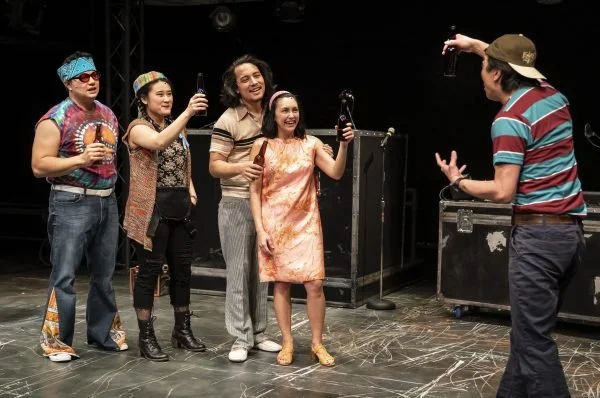
Peter Sipla (Rom), Eileen Doan (Pou), Matthew Yee (Leng), Aja Wiltshire (Neary), Greg Watanabe (Chum) in the Victory Gardens production in Chicago in 2019. Photo by Liz Lauren
How much do you know about the Cambodian genocide in the 1970’s? I actually know quite a bit about it, but only because I worked on a show about Cambodia in grad school. Before that, though, very little. Which is ridiculous, considering the US bombings in Cambodia during the Vietnam war. And that was not so long ago. All this is to say that I remember when this show was playing in Chicago, I really wanted to, but for some reason, was not able to see it. When I came across the script recently, I was very excited to read it. Lauren Yee’s rock and roll telling of one man’s personal story in the larger story of this terrible time in Cambodia’s history did not disappoint.
Summary: “In 1978, Chum fled Cambodia and narrowly escaped the murderous Khmer Rouge regime. Thirty years later, he returns in search of his wayward daughter, Neary. As the play jumps back and forth in time, thrilling mystery meets rock concert until both father and daughter are forced to face the music of the past. From playwright Lauren Yee (King of the Yees, The Great Leap) comes a story filled with horror, humor, pathos and songs by the best unknown rock band in Cambodia!” Concord Theatricals
Laura’s thoughts in brief: In grad school, as I mentioned, we did the eight hour epic play, The Terrible But Unfinished Story of Norodom Sihanouk, King of Cambodia, written by Hélène Cixous for Paris’ Théâtre du Soleil in the 1980’s. Knowing very little about the subject (why not, US schools?), I jumped headfirst into researching Sihanouk and the genocide by the Khmer Rouge and Pol Pot in Cambodia in the 70’s. This production was part of NIU’s Theatre in Context Humanities Festival, and there were several activities scheduled in addition to the show, including a talk with survivors. I remember sitting in that session, listening to this relatively young Cambodian woman describe her experiences, and having the extraordinary realization that this all took place while I was growing up peacefully and playfully, safe in the US. Were it not for an accident of geography, she could have been me, or I could have been her. I realize I’m dating myself here, but I think it’s important. This was one of the first times that the horrors of political violence sunk in completely, in a way that I truly understood. And the question of, “why didn’t I know about any of this?” also kept running through my mind. I don’t remember anyone talking about it in my world while it was happening (to be fair, I was quite young), and I definitely don’t remember anyone talking much about it afterwards. I was educated at a pretty good high school, but we never talked about Cambodia (or even Vietnam) in either World or US History class. Why not? By grad school, I had heard about Pol Pot, vaguely understood that he was a “bad guy”, but even then didn’t really know anything about what happened during that time. Oh, America, sigh.
So, the play. By making this a story about one individual’s experience (well, a few people’s, but Chum is really the main character in the story), it humanizes the horrors of the Khmer Rouge’s “cleansing” of all professionals, government leaders and workers, religious people, ethnic minorities, artists and intellectuals from the country. Whew. Also, ROCK N’ ROLL! What American can’t relate to rock and roll! But the rock band element of the play humanizes this character (and others) even more, and really helps us realize the Cambodia of the 70’s wasn’t that far away from our time. This is a period piece, but one we in the 21st century can relate to. Who hasn’t had fantasies of being a famous singer in a rock and roll band at one point in their life? Come on, when you’re home alone, tell me you’ve never sung into a hairbrush or strummed an air guitar along with your favorite song playing at all decibels?
And, although it’s Chum’s story, it’s also his daughter Neary’s. There were not many female characters in our Sihanouk play, other than dancers, a wife and a mistress, as I recall (a bit fuzzily, to be fair, there was probably a servant or two, and a few peasant women). Chum would not be telling his story if Neary wasn’t pushing him to. Yee’s play also leaves us with the reminder that parents have SO many life stories that they don’t tell their kids until they are grown-ups, if at all. That hit home for me profoundly.
Then we have the villain of the play, Duch (an actual historical figure - the first person to be tried for the war crimes committed by the Khmer Rouge), who runs S21, one of the detention camps where Cambodians are tortured and “disposed of”. Early on in the play he interrupts the rock band to introduce himself and remind us of “the Khmer Rouge, Pol Pot, and two million dead.” He is gleefully villainous in talking about enjoying torture and having people killed off, but we learn that there is more to him than is obvious. When asked, he reveals that before the revolution he was a math teacher. “I asked for French, they gave me math. I asked to work in the supply unit, they gave me (Referring to S21) this.” Some of the villains of Cambodia’s story are there because they felt like they had no choice. Learn to kill or be killed? Which of us would not vote for survival? Some of us, but would you? Would I? I don’t know, honestly. And Duch’s love of music is the reason Chum stayed alive. He remains a villain, and yet, it’s not that simple.
The NY Times reviewer, Ben Brantley, wasn’t as impressed with the play as I was (although maybe the NYC production wasn’t as good as the Chicago one!) and went so far as to say, “It is as if Yee … feels that a subject as monstrous as the Khmer Rouge cannot be approached head-on. So she tugs us, by degrees, into the horror at her play’s center with bait-and-switch tactics, which include sitcom coziness, cheerfully packaged shock effects (including dark commentary by Duch) and good old rock ’n’ roll, Cambodian-style.” I think the coziness and rock n’ roll actually help us to more fully empathize with the characters and truly relate to the humanity of the story, both the good and bad parts. It makes the horrors even more shocking, because they are happening to people we’ve learned to care about through the play. Reading this play at this current time in history, it feels like a cautionary tale. It’s almost like it could actually happen to us here in this “GREAT” U.S. of A if we’re not careful… (I wear glasses, I’m an artist, I’m an academic, I’m a professional … I would definitely be on the list, as would most of the people I love.)
All of this being said, I’m very sad I missed the Chicago production. I hope someone does it again soon - I think it’s very timely now, scarily timely. But I would love to see it, regardless. Rock on!
READ MORE! Here’s what some of the critics had to say about productions:
https://news.wttw.com/2019/04/23/cambodian-rock-band-traces-musical-line-back-genocide-1970s
https://www.nytimes.com/2020/02/24/theater/cambodian-rock-band-review.html